How to Check Gym Capacity (Live, Before You Go, and For Gym Owners)
By Abhishek Upadhyay13 min read
Updated
To check gym capacity means one of two things. A member wants to know, "Is the gym crowded right now?" An owner wants to know, "How many people are inside right now, and how many can my floor safely hold?"
This guide answers both. It explains maximum capacity, live occupancy and peak hours in simple words. It shows how members check a crowd before they leave home, and how owners count and manage it. All money is in ₹, and the examples are from gyms like the ones in Indian cities.
What is gym capacity?
Three words get mixed up. They mean different things.
- Maximum capacity is the most people your gym can hold at one time, safely and comfortably. It comes from your floor area, your equipment and any limit your building or local rules set.
- Live occupancy is how many people are inside right now. It changes every few minutes.
- Peak hours are the times of day when live occupancy is highest. In most Indian gyms that is early morning and after office hours.
A simple way to remember it: maximum capacity is the size of the glass, live occupancy is how full it is now, and peak hours are when it fills up.

Maximum capacity vs membership capacity
Maximum capacity is about people at one time. Membership capacity is about how many members you can sell. A gym that holds 60 people at once can have far more than 60 members, because members come at different times and not every day.
If you want to work out how many members your floor can support, use our free gym capacity calculator. It starts from your floor area, opening hours and busiest window. This article is about the other question: how full is the gym at a given moment.
How members check gym capacity today
Members use a few simple ways to check how crowded a gym is before going.
1. Call or message the gym
The oldest way still works. The member calls or sends a WhatsApp message to the front desk and asks, "Is it busy right now?" It depends on the desk being free to answer, and the answer is a guess.
2. A live crowd meter on a website or app
Some gyms show a live crowd level on a web page or in their app. It usually says Quiet, Comfortable or Busy, and sometimes a number. One small gym's public crowd page we read shows a maximum of 15 people, calls it comfortable up to 8, and gives a forecast for every hour of the week. Its forecast was built from about 6,579 member visits over six months, assuming a 90-minute average workout.
Public sports centres in some countries also show a live crowd level in their booking apps, so members can pick a quieter slot.
3. Google's busy-times chart
For many gyms, Google Maps shows a "popular times" chart. It is based on phone location data, not the gym's own check-ins. It shows a rough pattern, not an exact live count.
4. Look at the gate
Members who live nearby just walk past and look. It works, but it is not a plan.
How gym owners check and manage capacity
For an owner, checking capacity is about counting people in and out. Here are the common ways, from cheapest to most automatic.
Paper register or manual headcount
Staff write each name and time in a register, or walk the floor and count heads. It costs nothing. But nobody writes the exit time reliably, so you never know how many are inside now. A headcount every hour is a snapshot, not a live number.
Excel or Google Sheets
Typing visits into a sheet is searchable. But it is typed after the fact, so it is never live, and a busy desk falls behind at 7 PM, which is the exact time you need the number.
Check-in software at the desk or on the member's phone
Staff tap the member's name on a screen when they arrive and when they leave. Or the member checks in from an app. The software keeps a running count of who is inside. This is the cheapest way to get a real live number without hardware.
Biometric or turnstile check-in
A fingerprint or face device at the door records each entry. With a door lock or turnstile, it can also stop entry. It costs more and needs setup, but it removes the human step. Our gym attendance tracking guide compares fingerprint, face, app and register methods in detail.
Occupancy counters and capacity alerts
Some setups use a sensor or camera at the door to count people, and send an alert when the gym nears its limit. These are less common in Indian gyms and add hardware cost. Ask the vendor how they count people who leave, because that is where counters go wrong.
Real-time occupancy: how the live number works
Live occupancy is simple maths:
People inside now = check-ins today − check-outs today
Then:
Occupancy % = people inside now ÷ maximum capacity × 100
Here is a worked example from an evening at a neighbourhood gym in Pune with a maximum capacity of 100.
| Time | Check-ins so far | Check-outs so far | People inside | Occupancy % |
|---|---|---|---|---|
| 5:00 PM | 30 | 18 | 12 | 12% |
| 6:00 PM | 72 | 40 | 32 | 32% |
| 6:30 PM | 98 | 53 | 45 | 45% |
| 7:00 PM | 131 | 61 | 70 | 70% |
| 7:30 PM | 160 | 78 | 82 | 82% |
| 8:30 PM | 190 | 142 | 48 | 48% |
At 6:30 PM, 45 people are checked in and still inside, so the gym is 45% occupied. By 7:30 PM it is 82%, past the 80% line where queues usually begin.
The check-out problem
The formula only works if people check out. Members often leave without telling anyone. If check-outs are missed, the count keeps rising all evening and stops meaning anything. Three fixes help:
- Ask staff to check members out at the desk as they leave, the same way they checked them in.
- Assume a fixed workout length, for example 90 minutes, and drop anyone checked in longer than that from the live count. That is how the crowd forecast above handles it.
- Use a door device that also logs exits, if your budget allows.
Capacity limits and safety
A capacity limit is not just a number on paper. It matters for three reasons.
- Safety. Crowded floors mean people walking behind lifters, bumping into racks and waiting too close to machines. Fire exits and changing rooms also have limits.
- Experience. A member who waits 15 minutes for a bench every evening starts to wonder why they pay.
- Equipment wear. A full gym wears out cardio machines and cables faster.
How to set a maximum capacity
There is no single legal number for every gym. A practical way:
- Measure the usable floor, without the reception, toilets and storage.
- Give each person enough space to train safely. Weight areas need more room than cardio rows.
- Check any limit in your building's fire or occupancy rules. Your landlord or local authority can tell you.
- Count your stations. If you have 12 cardio machines and 6 benches, more people than stations means queues.
- Pick the lowest of these numbers as your working maximum.
One fitness centre we read about set separate limits for each room: 20 people in the front room, 20 on the back floor, 9 on spin bikes and 57 in total. It also capped cardio at 35 minutes when others were waiting. Room-by-room limits are useful when one area fills before the rest.
Morning and evening batches
Indian gyms often run two rushes: 6 to 9 AM and 6 to 9 PM. You can set the same limit for both, but staff and trainer numbers often differ. If you have fewer trainers in the morning, a lower morning limit keeps the floor safe.
What to do when the gym is full
- Tell members at the desk how long the wait is likely to be.
- Point them to quieter areas, like stretching or functional zones.
- Put a short, polite time limit on cardio machines during peak hours.
- Share your quiet hours, so members can plan better next time.

Peak hours: find your busy times from attendance data
You do not need a special tool to find peak hours. If you record check-ins with a time, you already have the data.
- Take one normal month of check-ins. Avoid festival weeks and January.
- Count check-ins for each hour of the day, for each day of the week.
- Mark the hours above 80% of your capacity. Those are your peak hours.
- Look again each month. Peak hours shift with seasons, exams and office timings.
This chart shows an example gym with a maximum capacity of 60. The red bars are hours at or above 80% full.
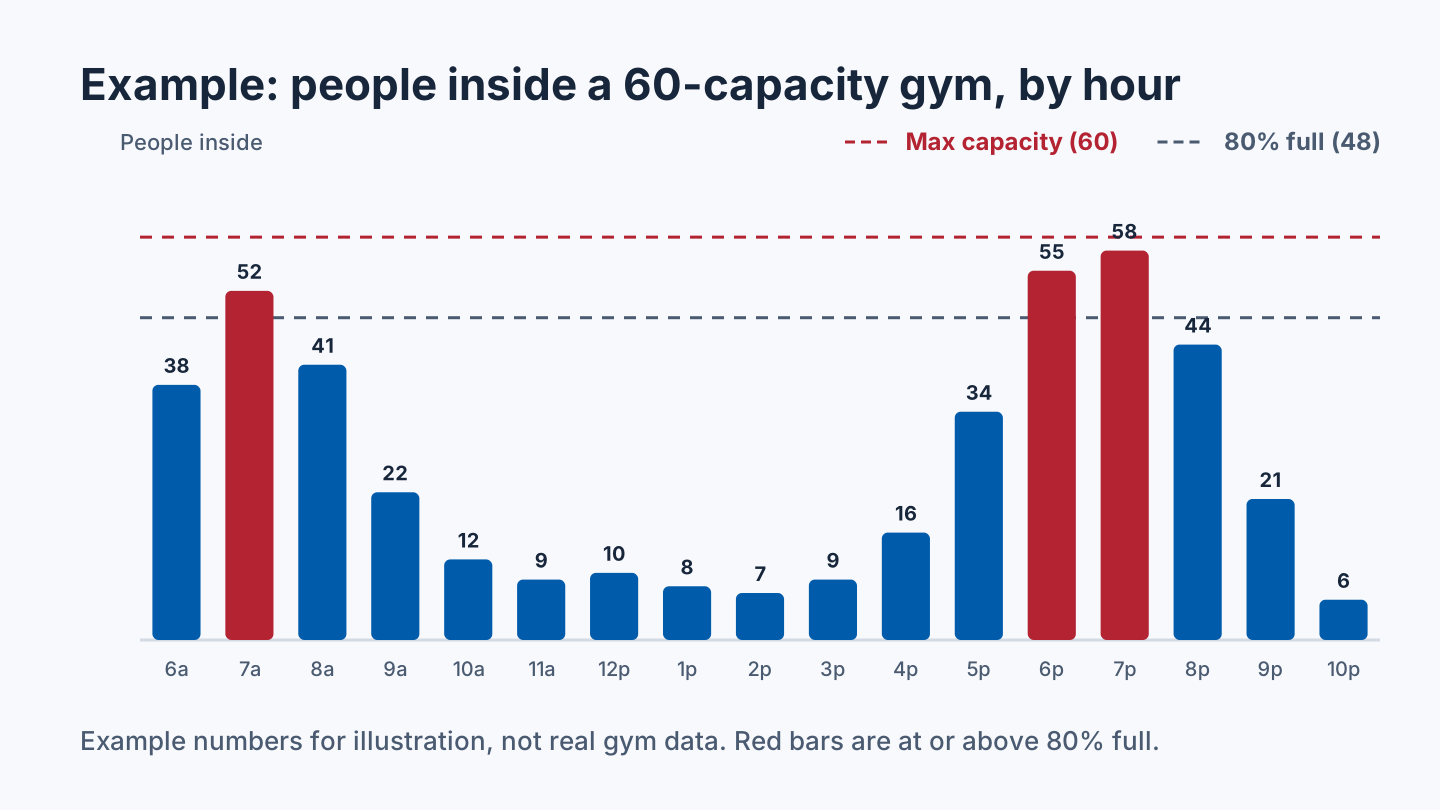
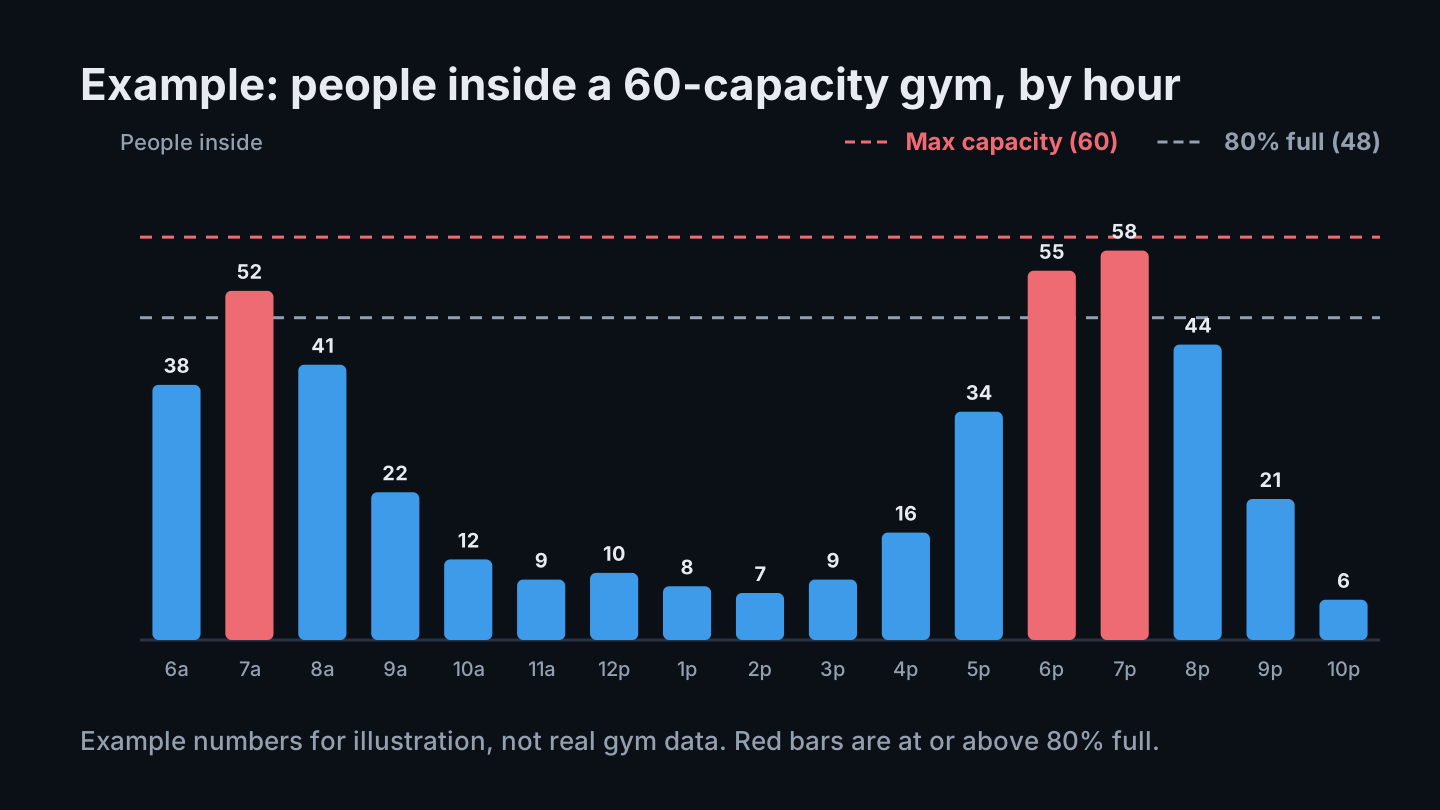
In this example, the gym is close to full at 7 AM (52 people) and from 6 to 7 PM (55 and 58 people). Between 10 AM and 3 PM, it never goes above 12. That quiet window is a chance:
- Offer a cheaper off-peak plan for students, homemakers and retired members.
- Schedule deep cleaning and machine repairs in the afternoon.
- Run personal training sessions when the floor is empty.
Gym capacity vs attendance tracking: how they connect
Capacity and attendance are two views of the same records. Attendance tracking asks, "Who came, and when?" Capacity asks, "How many are here now, and is that too many?"
If you track attendance well, with a time for each check-in and check-out, you get live occupancy and peak hours almost free. If you do not track attendance, you cannot check capacity at all, except by walking the floor and counting.
That is why most owners start with attendance. Once every visit is recorded, the capacity numbers follow.
Paper register vs Excel vs check-in software
| Method | Cost | Time per visit | Accuracy | Live count? |
|---|---|---|---|---|
| Paper register | Almost ₹0 | 10-20 seconds of writing | Low, exits rarely written | No |
| Excel or Google Sheets | ₹0 if you have a computer | Typing, often done later | Medium, depends on staff | No |
| Check-in software (desk or app) | About ₹250 a month and up, by vendor | A tap on a screen or phone | High, if check-outs are taken | Yes |
| Biometric device + software | Device about ₹7,000-₹8,000, plus software | 2-3 seconds at the door | High for entries | Yes, if exits are logged |
Device and software costs vary by vendor and change often, so ask for an itemised quote.
How Zenvore helps you check gym capacity
Zenvore is gym management software for gyms in India. Here is what it does today that helps with capacity.
- Desk and phone check-in. Staff check members in and out from the web console. Members can check in themselves from the Zenvore app with geo-fence check-in, which only works inside the gym's area. Both are on every plan, from ₹990 a month.
- Today's floor. The attendance view shows who is in the building right now, with check-out when they leave. That is your live headcount.
- Full history. Every visit is saved with its time, per member, so you can count your own peak hours.
- Fingerprint and door lock. On Growth (₹1,890 a month) and Chain (₹3,490 a month), Zenvore works with Identix devices for automatic attendance and door lock. The device is bought separately.
- Every branch in one account. Each branch has its own records, and every plan covers unlimited branches.
Zenvore does not show a public crowd meter for members, and it does not send an automatic alert when the gym nears its limit. If you need those, ask in the demo what is possible for your setup.
See the gym attendance system page for how check-in works, or compare plans on the pricing page.
Frequently asked questions
How can I check how crowded my gym is before going?
Check your gym's app or website for a live crowd meter, look at the popular times chart on Google Maps, or call the front desk. If your gym has none of these, the safest bet is to avoid the usual peak hours of 6 to 9 AM and 6 to 9 PM.
What is the maximum capacity of a gym?
It depends on the gym. It comes from the usable floor area, the number of stations and any limit set by building or fire rules. A small gym might hold 15 to 30 people at once, and a large one a few hundred. Each gym should set and display its own number.
How do gyms track live occupancy?
They subtract check-outs from check-ins. Every member who checks in adds one, and every member who checks out removes one. The result is the number of people inside right now. Software, fingerprint devices and door counters do this automatically.
What is a good occupancy % for a gym?
There is no fixed standard. A simple working rule is to treat 80% of your maximum capacity as the warning line, because queues at the busiest machines usually start before the gym is completely full. Then check your own numbers against member complaints.
How do I check gym capacity as a gym owner?
Record every check-in and check-out with a time. Then people inside equals check-ins minus check-outs, and occupancy % equals people inside divided by your maximum capacity. Check-in software gives you this number live, without counting heads.
How do I find my gym's peak hours?
Take one normal month of check-ins and count them for each hour of the day. The hours above 80% of your capacity are your peak hours. Repeat every month, because peak hours shift with seasons and office timings.
Is gym capacity the same as how many members I can have?
No. Capacity is how many people fit at one time. You can sell many more memberships than that, because members visit at different times. The free gym capacity calculator on zenvore.com estimates how many members a floor can support.
See how memberships, attendance and collections work together in Zenvore’s gym management software india.